
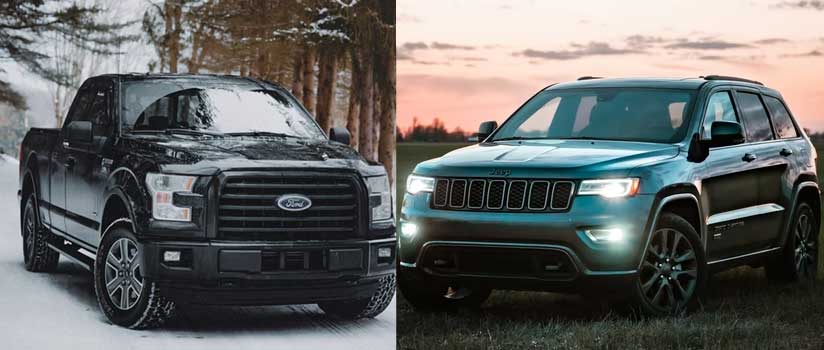
People don’t really buy SUVs or trucks because of specs, they buy them because they “feel” safer. Bigger body, higher seat, heavier stance. It gives confidence. Almost like you’re “above” risk. However, while quality build is a key front line in safety, it’s more about how your vehicle behaves when everything goes wrong at once; braking, swerving, weight shifting, tires gripping or failing.
And that’s where trucks and SUVs start separating in ways you don’t see in ads.
- Payload, Braking Distances, and Mass Inertia
This is where drivers get humbled by physics. A truck without cargo on high speed isn’t neutral, it’s imbalanced. Weight sits forward, over the engine, while the rear becomes lighter. During hard braking, that imbalance shows up instantly. The rear tires lose authority faster, and stopping distances stretch just enough to matter in emergencies. Nonetheless, loading within recommended weight is equally important.
However, SUVs generally offer a more balanced static front-to-rear weight, often close to 52/48, because the heavy glass, seats, and bodywork enclose the entire frame. That gives them a more consistent braking footprint. But both vehicles share the same core truth: once momentum builds, it doesn’t care what you drive, especially during panic stops.
- Heavier mass = harder stopping demand
- Higher speed = exponential braking load
- Worn brakes = instant disadvantage
And this is where most “vehicle safety” arguments fall apart. Because no matter what you drive, brake health becomes the real deciding factor; not brand, not size, not marketing claims.
That’s where leveraging the expertise of reliable mechanics like D. Wells Auto for all your brake needs, whether brake caliper rebuilding, master cylinder servicing, brake line diagnostics, or brake rotor resurfacing, is crucial in ensuring that your vehicle’s mechanical realities match its safety engineering, transforming a theoretical braking footprint into reliable, predictable stopping power.
- Center of Gravity and Rollover Dynamics
Let’s strip away the marketing: height is a double-edged sword. Pickup trucks are built for work. That means clearance, rugged suspension, and a structure designed to carry loads, not just passengers. When the bed is empty, all that height becomes vulnerability. In fast lane changes or panic steering, physics starts pulling upward, not forward. That’s where rollover risk quietly increases.
SUVs don’t escape physics either, but most modern ones are engineered with a more controlled weight spread. Especially unibody designs, they sit lower in stance, feel more planted, and don’t react as “top-heavy” under stress.
However, while electronic stability control helps both, here’s the reality check most drivers never hear:
- Stability control can *react*
- It cannot correct bad tires
- It cannot fix worn shocks
- It cannot undo poor maintenance decisions
So the real difference often isn’t the badge, it’s whether the suspension underneath is actually healthy enough to hold the vehicle stable when things get aggressive.
- Crash Compatibility and Kinetic Dispersion
When metal meets metal, branding stops mattering. Physics takes over. SUVs are usually built on unibody structures. That means the body is designed to absorb energy in stages, like controlled collapse points that spread force away from passengers. It’s intentional deformation, not weakness.
On the other hand, pickup trucks often rely on body-on-frame construction. That frame is strong, almost stubbornly so. It resists bending, which is great for hauling, towing, and durability. But in collisions, that same rigidity changes how energy moves. Instead of absorbing, it can transfer force more directly depending on impact angle and vehicle pairing.
In real-world crashes, this creates an uncomfortable reality:
- SUVs tend to “give” in controlled zones
- Trucks tend to “hold,” shifting force differently
Neither is automatically safer. They’re just built with different philosophies; one designed to absorb, the other to endure. And on shared roads, those philosophies interact whether drivers think about it or not.
- Active vs. Passive Safety Suites
Modern vehicles don’t just protect you in crashes anymore, they try to stop you from reaching them. For example with digital capabilities like blind-spot monitoring, lane assistance, automatic braking systems; they all create a digital safety net. But here’s the part people over-trust: these systems don’t see reality. They interpret it through assumptions.
SUVs usually benefit from better general visibility and more centered driving geometry. Trucks give you height advantage, but also larger blind zones that demand more system intervention.
However, even the smartest safety tech has limits:
- It assumes tires are gripping correctly
- It assumes alignment is precise
- It assumes suspension geometry is stable
If any of those drift, the system starts making decisions based on a “perfect vehicle” that no longer exists. So yes, tech helps. But it only behaves as well as the machine underneath it allows. Hence, identifying a reliable auto repair shop is crucial for optimizing all safety capabilities of your vehicle.
In essence, there’s no clean winner between trucks and SUVs, only different ways of handling risk. One leans toward controlled absorption, the other toward structural resistance. But both depend on the same foundation: mechanical honesty. Because in real driving, safety isn’t decided at the dealership. It’s decided in how well the vehicle is maintained when nobody is watching. That’s why a precision-focused vehicle repair service provider is a crucial partner in ensuring your vehicle achieves the best performance while enhancing its safety features.


More Stories
Why Remanufactured Transfer Cases Deliver Exceptional Performance
Revving Up the Future: How AI is Steering the Automotive Revolution
Revving Up the Future: How Electric Cars Are Driving a Green Revolution